
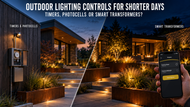
Outdoor Lighting Controls for Shorter Days: Timers, Photocells or Smart Transformers?
Sep 24th 2026
As the days get shorter, outdoor lighting begins working longer hours. A system that seemed perfectly timed during summer may suddenly come on after the walkway is already dark, stay on longer than necessary or require frequent manual adjustments.
The right lighting control solves that problem. Mechanical timers, photocells and smart transformers can all automate a low-voltage landscape lighting system, but they do it in different ways. Understanding those differences makes it easier to choose the level of control that fits your property and routine.
Mechanical Timers Keep a Consistent Schedule
A mechanical timer is the most straightforward option. You select the times when the lighting system should turn on and off, and the timer repeats that schedule each day. Alliance offers timers and photocells for compatible landscape lighting systems.
This approach works well when you want predictable operation, such as having path and entry lights turn on before guests arrive and shut off after bedtime. It is simple, dependable and easy to understand.
The tradeoff is that sunset does not remain at the same time throughout the year. As daylight hours change, a fixed timer may need to be reset. Power interruptions can also affect some timer settings, so it is worth checking the schedule periodically.
Photocells Respond to Available Light
A photocell turns the system on when surrounding light drops below a certain level. Instead of following a fixed clock time, it responds to actual outdoor conditions. That means the lights naturally come on earlier in fall and winter and later during spring and summer.
Photocells are a strong choice for homeowners who want their landscape lighting to follow dusk without seasonal reprogramming. Depending on the transformer and controls being used, the system may operate from dusk until dawn or combine photocell activation with a timed shutoff.
Placement matters. A photocell should have a clear view of natural light and should not face a fixture, window or other artificial light source. If the sensor detects light from the system it controls, it may cause inconsistent operation.
Smart Transformers Provide More Flexible Control
For more control, Alliance intelligent and Bluetooth transformers combine low-voltage power with app-based scheduling. These systems are designed for customers who want to manage lighting from a phone, create more precise schedules or divide a property into separate lighting zones.
Alliance IT2 intelligent transformers support Bluetooth or Wi-Fi control through the Alliance ITPro app. They offer clock-based schedules as well as astronomical timing that adjusts around sunrise and sunset. Up to three lighting zones can be scheduled independently, allowing a front walkway, architectural lighting and a water feature to operate at different times.
Smart control can be especially useful when the property has several lighting areas or when schedules change throughout the year. It also reduces the need to visit the transformer whenever you want to adjust operating times.
Which Control Is Right for Your System
Choose a mechanical timer when you want a simple, repeatable schedule and do not mind making occasional seasonal adjustments.
Choose a photocell when you want the lights to respond automatically to changing daylight. It is one of the easiest ways to keep a landscape lighting system aligned with earlier sunsets.
Choose a smart transformer when you want app-based access, automatic sunrise and sunset adjustments, multiple schedules or independent control of different lighting zones.
The control method is only one part of selecting a transformer. The transformer must also be properly sized for the total wattage of the connected fixtures and compatible with the system components. If you are replacing or upgrading an existing transformer, confirm the electrical requirements before making a selection.
Give Your Lighting System a Fall Check
The transition to shorter days is a good time to confirm that the entire system is ready for longer nightly operation. Check the timer or app schedule, clean the photocell, inspect fixtures for dirt or plant growth, and look for damaged wire or loose connections. Replace burned-out or dim bulbs and confirm that each fixture is still aimed where it is needed.
A few small adjustments now can improve safety, curb appeal and reliability throughout the darker months ahead.
Put Your Outdoor Lighting on the Right Schedule
The best outdoor lighting system should be ready when you need it without requiring daily attention. Whether that means a straightforward timer, a dusk-sensing photocell or a smart transformer with app-based control depends on the size and complexity of your system.
All Alliance Lighting offers transformers, timers, photocells and smart controls to help keep Alliance outdoor lighting operating on the right schedule as the seasons change.